Which States Are Leading the Way in Behavioral Health Value-Based Care

Carolyn Bradfield
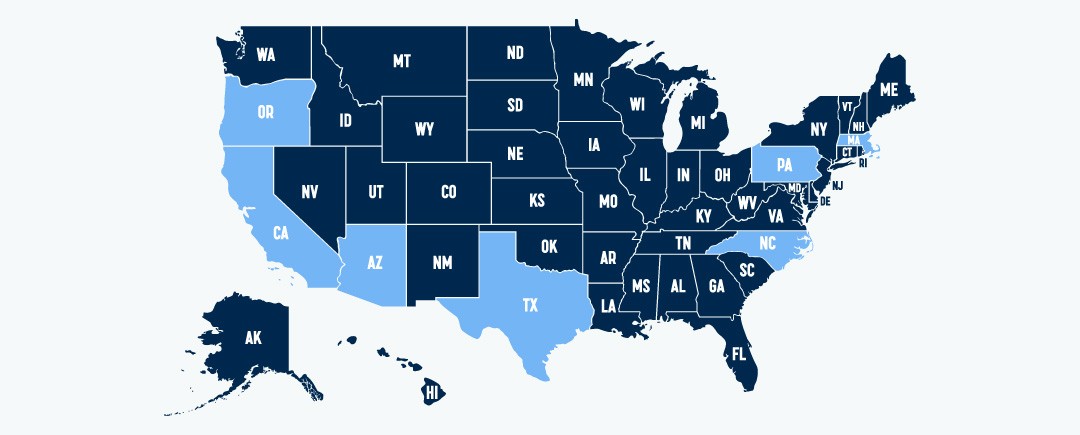
The shift to value-based care in behavioral health is real, but it isn't happening at the same pace everywhere. Treatment programs operating in California today are negotiating contracts that look fundamentally different from what's available in states with no managed care VBC infrastructure at all. The gap between leading and trailing states is years wide — and growing.
For operators, this matters in two ways. First, it shapes which contracts you can compete for and on what terms. Second, it gives you a forward look at where the rest of the market is going. The states leading today are running the playbook the rest of the country will run by 2030.
Here's the current map.
California: CalAIM Sets the Pace
California's California Advancing and Innovating Medi-Cal (CalAIM) initiative, approved by CMS in late 2021 and launched as a five-year extension of the state's 1115 demonstration waiver, is the most ambitious state-level VBC restructuring in behavioral health to date.
CalAIM consolidated previous Medi-Cal initiatives — Whole Person Care pilots and the Health Homes Program — into a unified model built around two core mechanisms:
Enhanced Care Management (ECM), providing intensive coordination for Medi-Cal members with complex needs
Community Supports (formerly "in lieu of services"), allowing managed care plans to substitute non-traditional services for traditional medical care when those services produce better outcomes
The early data is significant. Los Angeles County's psychiatric recuperative care service, delivered as part of the CalAIM framework, produced a 71% reduction in hospital readmissions and a 24% reduction in emergency department visits. Whole Person Care pilots showed measurable decreases in inpatient utilization and improvements in preventive care engagement.
For treatment programs, CalAIM means: Medi-Cal managed care plans now have direct financial incentives to contract with providers who can demonstrate outcomes, deliver community-based supports, and integrate behavioral health with physical health and social services. Programs without that infrastructure are watching contracts move to programs that have it.
Massachusetts: Behavioral Health Inside Accountable Care
Massachusetts has been pioneering behavioral health value-based payment longer than most states. The state's Behavioral Health Community Partners (BH-CP) program is a particularly distinctive model.
BH-CPs are community-based organizations that coordinate care for Medicaid members with significant behavioral health needs, contracting directly with the state and partnering with managed care organizations and Accountable Care Organizations (ACOs). All MCOs are required to sign agreements with BH-CPs, and Partnership ACOs must enroll defined volumes of members with them.
Massachusetts also runs a primary care sub-capitation program inside its accountable care framework, paying primary care practices capitated rates that include behavioral health integration capabilities — from screening at the entry tier to consulting behavioral health prescribers at the highest tier.
For treatment programs, the Massachusetts model means: behavioral health is structurally inside the accountable care system, not adjacent to it. Programs that integrate with primary care, demonstrate measurable outcomes, and partner with BH-CPs have a clearer path to value-based contracts than programs operating in isolation.
CMS Innovation in Behavioral Health: Michigan, New York, South Carolina
The Centers for Medicare & Medicaid Services launched the Innovation in Behavioral Health (IBH) Model in 2025, running through 2032. The model puts behavioral health providers at the center of value-based, integrated care for Medicare and Medicaid beneficiaries with moderate-to-severe behavioral health conditions, substance use disorders, or both.
Initial state participants:
Michigan
New York
South Carolina
Up to eight states are expected to participate over the model's life. Practice participants receive per-member-per-month payments to support required activities including behavioral and physical health screenings, social-determinant assessments, and care plan integration.
The IBH Model is significant because it's federal, it's multi-state, and it's running a unified set of payment and quality requirements across participating states. For programs in the three current states, IBH represents the most direct path into value-based behavioral health. For programs in non-participating states, it's a forward indicator: when CMS expands the model, the requirements they're imposing on Michigan, New York, and South Carolina will become the template.
Oregon: Coordinated Care Organizations
Oregon's Coordinated Care Organizations (CCOs) have integrated mental health, addiction services, and physical care under a single capitated payment structure since 2012. CCOs receive a fixed per-member payment to manage the full health needs of Medicaid enrollees in defined service areas.
For behavioral health providers, the CCO structure means contracts that emphasize integration with primary care, longitudinal patient engagement, and outcome reporting. Oregon has been refining the model for over a decade, making it one of the more mature state-level VBC environments in the country.
Texas: VBP Inside Medicaid Managed Care
Texas's path is different. Rather than restructuring the Medicaid system around VBC, the state requires its managed care organizations to advance alternative payment models inside their existing networks. MCOs must demonstrate measurable progress on alternative payment model initiatives in priority areas — including behavioral health integration.
This shows up in programs like STAR+PLUS (for Medicaid members with disabilities and adults age 65+), where managed care contracts incorporate behavioral health performance measures and outcome targets.
For treatment programs operating in Texas, the leverage point isn't a state-level VBC model. It's the contract you negotiate with the MCO — and your ability to demonstrate the outcome data those contracts will increasingly require.
North Carolina, Pennsylvania, and Others
Several other states are advancing meaningful behavioral health VBC, though usually through narrower mechanisms than California's CalAIM or Massachusetts's BH-CP framework.
North Carolina uses 1915(b)(c) waivers to fund behavioral health services and is moving its Medicaid reforms toward outcome-based progress measurement.
Pennsylvania has Medicaid programs operating under performance-based contracts that reward providers for proven outcomes in behavioral health recovery.
Washington, Idaho, and Utah are using a mix of managed care contract requirements and directed payment programs to push providers toward behavioral health integration.
The National Academy for State Health Policy (NASHP) has documented that 43 states use Medicaid managed care contract requirements to advance behavioral health integration in some form. Not all of that activity rises to the level of true value-based care, but the directional trend across the country is consistent: payors are using contracts to push providers toward outcomes accountability.
What This Map Means for Operators
The map of behavioral health VBC isn't uniform. It's a leading edge — California, Massachusetts, the IBH Model states — followed by a long tail of states implementing pieces of the model.
Two implications:
If you operate in a leading state. The contracts you're competing for next year will require outcome tracking, family integration, alumni engagement, and care coordination at depth. Programs with that infrastructure will win the contracts. Programs without it will see their footprint shrink as managed care organizations consolidate around providers who can deliver.
If you operate in a trailing state. The leading-state playbook is your forward look. The contract structures appearing in California today will appear in your state within five to seven years — sooner if your state opts into the IBH Model expansion or pursues its own 1115 waiver restructuring. Programs that build VBC infrastructure now have a 5-7 year head start when their state catches up.
For multi-state programs, the implication is sharper: you can't run a single operating model across leading and trailing states. The infrastructure required to compete in California is substantially different from what you need in a state still running on fee-for-service.
The states that lead today are showing the rest of the industry where the next decade is heading. The faster operators read the map, the better positioned they'll be when the destination is everywhere.
Frequently Asked Questions
Which state has the most advanced behavioral health value-based care?
California and Massachusetts are widely considered the most advanced. California's CalAIM initiative restructured Medi-Cal around value-based care principles starting in 2022 and has produced measurable outcomes, including 71% reductions in hospital readmissions in pilot programs. Massachusetts has been running behavioral health VBC inside its accountable care organization framework for over a decade through its BH-CP program and primary care sub-capitation.
What is the CMS Innovation in Behavioral Health (IBH) Model?
The IBH Model is a CMS Innovation Center program running from 2025 through 2032 that places specialty behavioral health providers at the center of value-based integrated care for Medicare and Medicaid beneficiaries. Initial participants are state Medicaid agencies in Michigan, New York, and South Carolina, with up to eight states expected over the model's lifespan.
Are private insurers also moving to value-based behavioral health?
Yes, though usually behind Medicaid. Private insurers and employer health plans are increasingly building VBC provisions into behavioral health network contracts — particularly performance-based bonuses tied to engagement metrics and quality measures. The fastest-moving private VBC adoption tends to follow Medicaid leadership in the same state.
How do treatment programs negotiate value-based contracts?
The terms vary widely by state, payor, and contract type. Common negotiating dimensions include: target population definition, performance benchmarks, reporting cadence, risk-sharing structure (P4P vs. shared savings vs. shared risk), and which outcome instruments will be used. Programs without strong outcome data have limited negotiating leverage. Programs with longitudinal outcome data have substantial leverage.
What if my state isn't on this list?
Look at CMS Adult Core Set reporting and your state's Medicaid managed care contract requirements. Even states without high-profile VBC initiatives are usually requiring some form of outcome reporting, behavioral health integration, or alternative payment model adoption inside their managed care contracts. The trend is national even where the implementation is local.
Sources
Centers for Medicare & Medicaid Services. Innovation in Behavioral Health (IBH) Model. CMS Innovation Center, 2025.
National Academy for State Health Policy (NASHP). How States Leverage Medicaid Managed Care to Foster Behavioral Health Integration, 2025.
NASHP. CalAIM: Leveraging Medicaid Managed Care for Housing and Homelessness Supports, 2025.
CMS. CMS Behavioral Health Strategy.
Massachusetts Medicaid (MassHealth). Behavioral Health Community Partners (BH-CP) Program.
value-based care, Medicaid, behavioral health, state policy, CalAIM, CMS IBH Model, Massachusetts, accountable care